

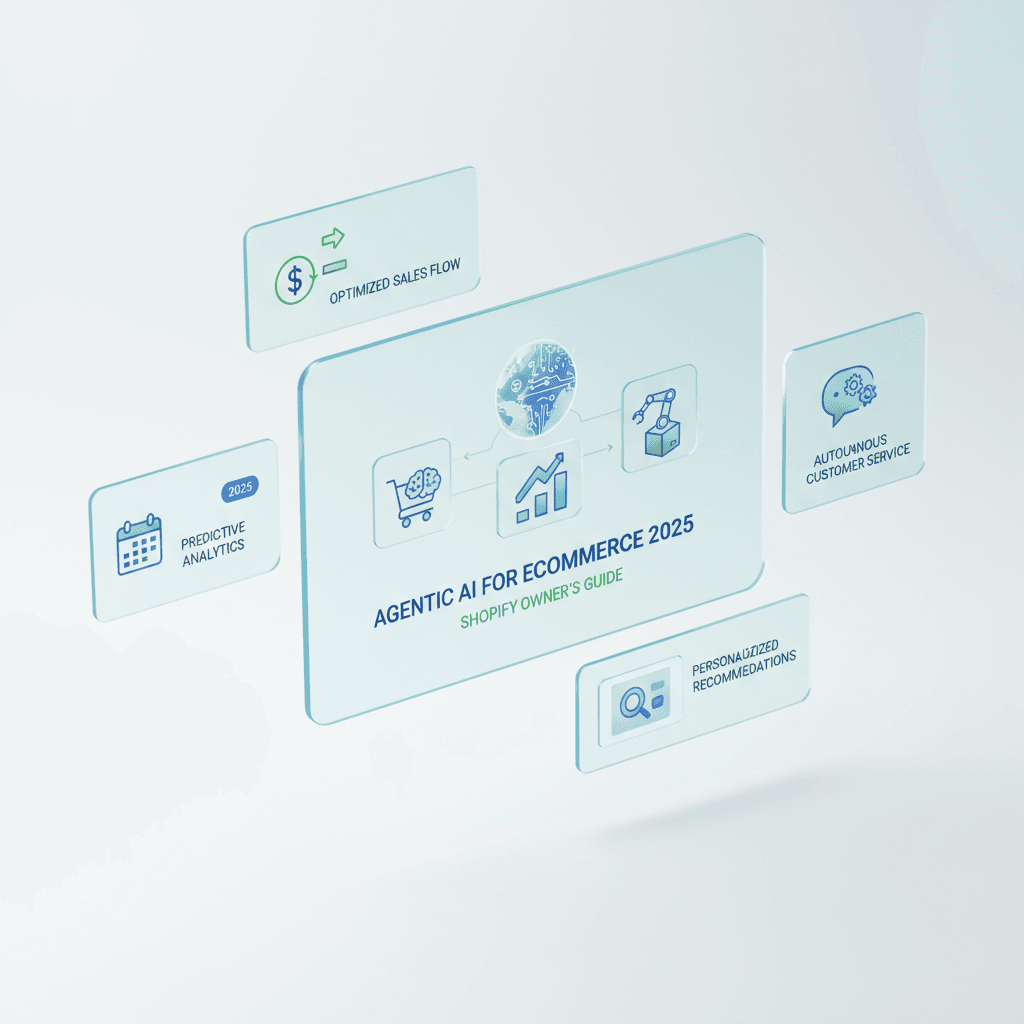
Agentic AI for Ecommerce 2025: Why Generic Chatbots Are Leaving Money on the Table
Agentic ai for ecommerce 2025 is no longer a buzzword reserved for enterprise boardrooms — it’s the operational edge that separates Shopify stores growing at 40% year-over-year from those stuck plateauing on basic automation. If you’re still relying on rule-based chatbots and manual inventory checks, you’re competing with merchants who’ve deployed AI that predicts, decides, and executes — all without a human in the loop.
The core problem is this: traditional ecommerce tools are reactive. They wait for a customer to ask a question, for stock to run out, or for a cart to be abandoned before triggering a response. Agentic AI flips that model entirely. As Graas.ai puts it: “It was only a matter of time before your eCommerce systems don’t just interpret data — they make decisions and execute strategies, all without human intervention.”
McKinsey has called this shift transformational: “Agentic AI promises to radically remake the entire shopping experience.” And the numbers back it up — 71% of consumers expect personalized interactions, and 76% get frustrated when they don’t receive them. That frustration translates directly into abandoned carts and lost revenue.
In this guide, we compare three of the most capable agentic AI platforms available to Shopify store owners right now: Rep AI, Impact Analytics, and Kore.ai. Each takes a different approach to autonomous commerce, and the right choice depends entirely on where your biggest revenue leaks are. To learn more about how agentic AI is reshaping ecommerce marketing at a strategic level, that external resource is worth your time before diving in.
What Agentic AI for Ecommerce 2025 Actually Means (And Why It’s Different)
Before comparing tools, let’s establish what separates agentic AI from the automation you’ve already tried. Standard automation follows if-then logic: if a cart is abandoned, send an email. Agentic AI for ecommerce 2025 operates on a fundamentally different architecture — it perceives context, reasons about outcomes, plans multi-step actions, and executes them autonomously.
Think of it as the difference between a vending machine and a skilled sales associate. The vending machine dispenses what you press. The sales associate notices you’re hesitating, asks the right question, suggests a complementary product, processes your payment, and follows up afterward — all without being told to do each step.
Key capabilities that define genuine agentic AI in this space include:
- Autonomous decision loops — the AI takes action, measures results, and adjusts strategy without human prompts
- Cross-system orchestration — connecting inventory, CRM, pricing engines, and customer data in real time
- Predictive intervention — acting before problems occur (stockouts, churn, price erosion) rather than reacting after
- Goal-directed behavior — optimizing toward business outcomes like margin, LTV, or conversion rate, not just task completion
OpenAI and Stripe recognized this shift early enough that they launched the Agentic Commerce Protocol (ACP) in early 2025, standardizing how AI agents make purchases across platforms. That’s how seriously the infrastructure layer is taking this transition. For a deeper look at real-world use cases across retail, learn more from EverWorker’s comprehensive breakdown.

Tool #1: Rep AI — Agentic AI for Ecommerce 2025 on the Sales Floor
Rep AI was built with one obsession: turning Shopify store visitors into buyers through autonomous, conversational AI that behaves less like a chatbot and more like your best-performing sales rep. It’s one of the most purpose-built examples of agentic ai for ecommerce 2025 in the direct-to-consumer space, and after testing it across multiple store configurations, the results are genuinely impressive.
Core Features
Rep AI’s flagship capability is its behavioral AI engine, which monitors visitor signals in real time — scroll depth, time on page, mouse hesitation, traffic source — and proactively initiates conversations at the exact moment a shopper is most likely to convert or most at risk of leaving. This is not a pop-up trigger. It’s a contextual intervention based on predicted intent.
The product recommendation engine pulls live inventory data and uses purchase history, browsing behavior, and catalog relationships to suggest products that actually make sense in context. During a test scenario involving a skincare brand, Rep AI correctly identified that a visitor browsing SPF moisturizers had previously purchased a vitamin C serum and proactively recommended a bundle — without any manual configuration.
Cart recovery is handled autonomously. Rep AI identifies abandonment signals before the cart is technically abandoned and engages the shopper with relevant messaging, discount logic (configurable by merchant), and urgency cues — all within the same conversation thread. Post-purchase, the agent handles order tracking queries, return initiation, and upsell conversations without escalating to human support unless the issue requires it.
The platform also offers deep Shopify integration out of the box, including access to product metafields, customer tags, and order history. This means the AI has the context it needs to be genuinely useful rather than generically helpful.
Pricing
Rep AI operates on a tiered SaaS model. The Starter plan begins at approximately $79/month for stores with up to 1,000 monthly conversations. The Growth plan, which unlocks advanced behavioral triggers and A/B testing for conversation flows, runs around $199/month. Enterprise pricing is custom and includes dedicated onboarding, SLA guarantees, and API access for deeper integrations.
Pros
- Genuinely proactive — initiates conversations based on predicted behavior, not just rules
- Deep Shopify-native integration with live inventory and order data
- Autonomous cart recovery that operates mid-session, not just via email
- Clean merchant dashboard with conversion attribution per AI interaction
- Fast setup — most stores are live within 48 hours
Cons
- Primarily focused on customer-facing sales; limited backend operations capability
- Conversation volume caps on lower tiers can be restrictive during peak seasons
- Less effective for B2B or wholesale Shopify stores where purchase logic is complex
- Custom AI training requires higher-tier plans
For Shopify merchants whose primary pain point is conversion rate and customer service load, Rep AI delivers measurable ROI quickly. If you want to explore how AI chatbot infrastructure supports this kind of deployment, our AI Chatbot Solutions page covers the technical architecture behind building and scaling these systems.
Tool #2: Impact Analytics — Agentic AI for Inventory and Demand Forecasting
While Rep AI owns the customer-facing layer, Impact Analytics attacks the operational core of ecommerce profitability: inventory, demand forecasting, and supply chain intelligence. For Shopify merchants managing hundreds of SKUs across multiple warehouses or 3PLs, this is where agentic ai for ecommerce 2025 delivers some of its most financially significant outcomes.
Core Features
Impact Analytics uses machine learning models trained on your historical sales data, external demand signals (weather, seasonality, local events, macroeconomic indicators), and supplier lead times to generate demand forecasts at the SKU-location level. What makes it agentic rather than simply predictive is that it doesn’t just surface a forecast — it recommends and, in integrated deployments, executes purchase orders, stock transfers, and markdown triggers autonomously.
The platform’s inventory optimization module continuously rebalances stock across fulfillment nodes. If a product is trending in one region based on real-time sales velocity, the system can autonomously initiate a transfer from an overstocked warehouse before a stockout occurs at the high-demand location. This is genuinely agentic behavior: perceive, reason, act, monitor.
Pricing intelligence is another strong suit. Impact Analytics monitors competitor pricing, margin thresholds you define, and demand elasticity to recommend or execute dynamic price adjustments. In testing, the system correctly identified a competitor price drop on a hero SKU and recommended a targeted promotional response within the same business day — without a human analyst flagging the change.
The platform also includes a merchandising AI layer that manages product assortment recommendations, identifying which SKUs to promote, which to phase out, and which have latent demand worth unlocking through better placement or bundling.
Integration with Shopify is available via API, and the platform connects with major ERP systems, 3PLs, and data warehouses including Snowflake and BigQuery. For complex workflow automation between Impact Analytics and your broader tech stack, n8n Workflow Automation Services can bridge the gap where native integrations fall short.
Pricing
Impact Analytics is an enterprise-grade platform. Pricing is not publicly listed and is scoped based on number of SKUs, locations, and modules required. Based on market intelligence, entry-level deployments typically start around $2,000–$3,000/month, with full-suite implementations for mid-market retailers ranging from $5,000–$15,000/month. This positions it firmly as a tool for Shopify Plus merchants and established DTC brands, not early-stage stores.
Pros
- Best-in-class demand forecasting with external signal integration
- Autonomous inventory rebalancing across multi-location fulfillment networks
- Dynamic pricing with margin guardrails — the AI won’t race to the bottom
- Strong analytics and explainability — merchants understand why the AI made each decision
- Scales effectively from hundreds to tens of thousands of SKUs
Cons
- Significant investment — not viable for stores under $2M annual revenue
- Implementation timeline of 4–8 weeks before full autonomous operation
- Requires clean, structured historical data — messy data pipelines need remediation first
- Less focus on customer-facing AI; pairs best with a separate CX tool
Tool #3: Kore.ai — Workflow Orchestration and Agentic AI for Ecommerce 2025 at Scale
Kore.ai approaches agentic ai for ecommerce 2025 from an orchestration perspective. Rather than owning a single function like sales or inventory, Kore.ai provides the infrastructure layer that lets you build, deploy, and manage multiple AI agents that work together across your entire ecommerce operation. Think of it as the operating system for your AI workforce.
Core Features
Kore.ai’s XO Platform allows merchants and their technical teams to design AI agents with defined goals, tools, memory, and decision-making logic using a low-code builder. You can create an agent that handles customer service escalations, another that monitors fraud signals, and a third that manages loyalty program interactions — and then orchestrate them to hand off context seamlessly when a customer interaction spans multiple domains.
The platform’s GALE (Generative AI for Language and Enterprise) module enables agents to reason using large language models while maintaining strict guardrails around brand voice, compliance, and escalation thresholds. This is critical for ecommerce brands where off-brand AI responses can damage customer trust instantly.
Kore.ai also supports voice, chat, email, and SMS channels natively, making it one of the few platforms capable of delivering a consistent agentic experience across every customer touchpoint. For Shopify brands with significant phone support volume, the voice AI capability is particularly compelling.
Pricing
Kore.ai offers a consumption-based pricing model starting with a free tier for development and testing. Production deployments are priced per session or per API call depending on the module. Mid-market ecommerce deployments typically run $1,500–$4,000/month depending on channel volume and agent complexity. Enterprise contracts include dedicated infrastructure and SLA commitments.
Pros
- Most flexible platform — build agents tailored to your exact workflows
- Multi-channel native (voice, chat, email, SMS) with consistent agent behavior
- Strong enterprise compliance and security certifications
- Agent orchestration layer enables complex multi-agent workflows
Cons
- Higher implementation complexity — requires technical resources or an agency partner
- Longer time-to-value than plug-and-play tools like Rep AI
- Shopify-specific integrations require custom development
For merchants who want to understand how AI agents are generating measurable ROI across different ecommerce categories, learn more from this breakdown of the top five agents delivering results in 2025.
Head-to-Head Comparison: Agentic AI for Ecommerce 2025
| Feature / Criteria | Rep AI | Impact Analytics | Kore.ai |
|---|---|---|---|
| Primary Use Case | Sales conversion & CX automation | Inventory, demand forecasting, pricing | Multi-agent orchestration & workflow |
| Shopify Native Integration | ✅ Out of the box | ⚠️ Via API (setup required) | ⚠️ Custom development needed |
| Autonomous Decision-Making | High (customer-facing) | High (operations) | Configurable (any domain) |
| Time to Value | 48–72 hours | 4–8 weeks | 2–6 weeks |
| Starting Price | ~$79/month | ~$2,000/month | ~$1,500/month |
| Best Store Size | SMB to mid-market | Mid-market to enterprise | Mid-market to enterprise |
| Multi-Channel Support | Chat only | N/A (backend operations) | Voice, chat, email, SMS |
| Technical Complexity | Low | Medium | High |
| Predictive Analytics | Behavioral intent | Demand & pricing forecasting | Configurable per agent |
| Free Trial Available | ✅ Yes | ❌ Demo only | ✅ Free dev tier |
Verdict: Which Tool Is Right for Your Shopify Store?
“The winners in 2025 will move from IT-led, months-long projects to business-led deployment where AI workers deliver results in days — and keep improving.” — EverWorker
This quote captures the strategic reality perfectly. The right agentic ai for ecommerce 2025 tool isn’t the one with the most features — it’s the one you can deploy fast enough to generate competitive advantage before your rivals do.
Choose Rep AI if:
- Your biggest revenue leak is conversion rate or customer support costs
- You’re a Shopify SMB or growing DTC brand under $5M revenue
- You want results within the first week of deployment
- You don’t have a dedicated technical team for implementation
Choose Impact Analytics if:
- Inventory inefficiency, stockouts, or overstock are your primary margin killers
- You manage 500+ SKUs across multiple fulfillment locations
- You’re a Shopify Plus merchant with $5M+ revenue and clean data infrastructure
- Dynamic pricing and demand forecasting are strategic priorities
Choose Kore.ai if:
- You need a flexible platform to orchestrate multiple AI agents across departments
- Your customer interactions span voice, chat, email, and SMS simultaneously
- You have technical resources or an agency partner to handle implementation
- You want to build proprietary AI workflows that competitors can’t replicate
Integration Considerations Before You Commit
Deploying agentic ai for ecommerce 2025 without a clear integration strategy is one of the most common (and costly) mistakes merchants make. Each of these platforms needs clean data pipelines to function at their best, and the quality of your existing tech stack directly determines how quickly you’ll see ROI.
Before implementation, audit these critical integration points:
- Customer data platform (CDP) — Does your chosen tool have access to unified customer profiles, or will it be working with siloed session data?
- Product catalog quality — AI recommendation engines are only as good as your product metadata. Missing descriptions, inconsistent tags, and absent metafields will degrade output quality significantly.
- Order management system (OMS) — For tools like Rep AI that handle post-purchase queries autonomously, real-time OMS access is non-negotiable.
- Analytics and attribution — Establish baseline metrics before deployment so you can measure the actual impact of agentic decisions on revenue and margin.
- Escalation workflows — Every agentic system needs a defined handoff protocol for edge cases. Build this before go-live, not after your first customer complaint.
For merchants who need custom automation bridges between these AI platforms and their existing Shopify tech stack, workflow orchestration tools become essential. The implementation phase for agentic AI in retail follows a proven sequence: start with customer experience improvements in months one through three, then layer in revenue optimization, operational efficiency, and advanced capabilities over the following nine months. Rushing this sequence typically results in underperforming deployments that get abandoned before they deliver value.
It’s also worth noting the broader infrastructure shift happening in 2025. With OpenAI and Stripe’s Agentic Commerce Protocol now standardizing how AI agents transact across platforms, the tools you choose today need to be protocol-compatible to remain viable as agentic commerce matures. Generative AI traffic in ecommerce surged above 2024 levels during Prime Day 2025 alone — the adoption curve is steeper than most merchants realize.
Final Recommendation: Start Narrow, Scale Fast
The most successful Shopify merchants deploying agentic ai for ecommerce 2025 share one common approach: they don’t try to automate everything at once. They identify the single highest-value use case — usually conversion rate optimization or inventory management — deploy one focused agent, measure rigorously, and then expand the scope based on proven results.
Rep AI wins for speed and accessibility. Impact Analytics wins for operational depth. Kore.ai wins for flexibility and scale. But all three represent a genuine shift in what’s possible when AI moves from answering questions to owning outcomes.
The merchants who treat agentic ai for ecommerce 2025 as a strategic capability — not a tactical tool — are the ones building defensible competitive advantages right now. The question isn’t whether to deploy agentic AI. It’s which outcome you want to own first.
As you evaluate your options, remember that the implementation partner you choose matters as much as the platform itself. Agentic ai for ecommerce 2025 deployments that underperform almost always trace back to poor data quality, rushed integration, or misaligned success metrics — not the AI itself. Get those foundations right, and the results follow.
Your Team Is Drowning In Repetitive Tasks
We automate them with AI so you can focus on growth