
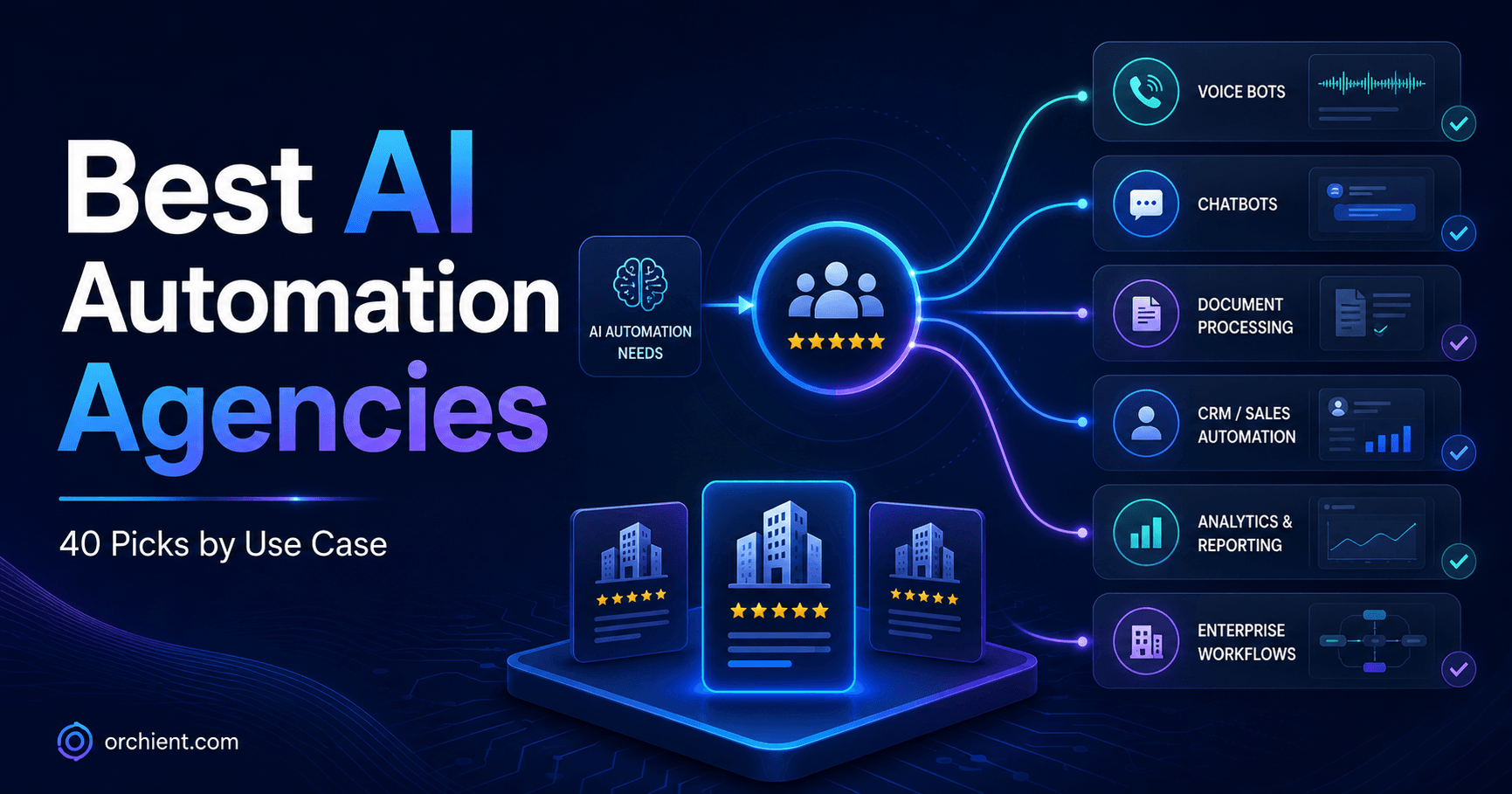
The AI automation agency market is crowded, and most “best agencies” lists are the same five enterprise names plus whoever paid for placement. This one is different in two ways: it’s sorted by what each firm actually does well — voice bots, document processing, full-stack builds — and it’s honest about the one entry we can’t be objective about (ours).
Whether your budget is $500 or $500K, there’s a category below that fits. Skip to the one that matches your problem.
How do you pick the best AI automation agencies? Start with the specific workflow you want automated, not the agency’s brand. Match it to a specialist in that category, confirm they’ll disclose their tech stack, and ask for evidence in your industry. Budget sets the tier: boutique shops start in the low hundreds per month; enterprise transformations begin around $250K.
Not sure which category your problem falls in? That’s the first thing we map in a free 30-minute automation audit — you leave with a written recommendation, even if it points you to someone else.
How we sorted this list (and what we didn’t do)
We did not run a lab benchmark of 40 agencies — nobody honestly can, and any list claiming a tidy “winner score” across firms this different is selling you something. Here’s the actual method:
- Categorized by core strength, not overall “rank.” A voice-AI specialist and an enterprise RPA firm don’t belong on the same 1-to-40 ladder.
- Descriptions reflect each firm’s public positioning as of June 2026. Performance figures are the vendor’s own claims, labeled as such — verify them before you sign anything.
- Disclosure: orchient.com is our agency. We’ve flagged it plainly and told you who we’re not right for, because that’s more useful than a fake coronation.
Who we excluded and why: pure resellers with no build capability; agencies that won’t disclose their stack (only a minority do); and “AI agencies” that are a single ChatGPT wrapper with a landing page. If a firm wouldn’t tell a prospect what they actually run under the hood, it didn’t make the list.
A note on us (full disclosure)
orchient.com is an AI automation agency built for operators, not enterprises. We specialize in n8n workflow builds, AI chatbots and agents, and automation consulting for non-technical business owners, ecommerce teams, and local-service businesses. One in-house team, two engagement models: done-for-you builds, or audit-and-advise.
We’re the right call if you want production-grade automation — lead pipelines, support bots, ops workflows — without an enterprise price tag or a six-month timeline.
We’re the wrong call if you’re a Fortune 500 running a multi-year, $250K+ transformation. That’s genuinely not us — scroll to the enterprise section and talk to Accenture or IBM. Saying so is the point: we’d rather lose a bad-fit lead than oversell.
Key takeaway: deep n8n/no-code engineering for operators who want it done right and done soon.
Boutique & SMB specialists
2. Boutique AI automation for SMBs. Shops like MQLFlow build usable automation for small teams using Zapier, HubSpot, and ChatGPT. MQLFlow publicly lists a day rate around £800 with no project minimum. Good when you want a senior operator, not a project plan.
3. Enterprise AI transformation firms. Accenture and Fractal Analytics handle Fortune 500 transformations with multi-year roadmaps; engagements typically start around $250K+. Right only if you have a dedicated innovation budget and a team to receive the work.
4. AI call-center automation specialists. Retell AI and NiCE lead here. Retell markets sub-second (~600ms) voice latency; NiCE sells an enterprise CX platform with AI across the journey. Good for automating high-volume inbound/outbound calls.
5. No-code AI workflow tools & partners. Gumloop, Zapier, Make, and n8n let non-developers build AI automations (Zapier advertises 7,000+ app connectors). Implementation partners help you choose and set up the right tool — see our n8n pricing breakdown before committing to a platform.
6. RPA + AI fusion experts. Firms like The Lab Consulting pair RPA (often UiPath) with AI for finance back-offices — reconciliations, fraud checks. Good for high-volume, rules-heavy processes.
Industry-specific specialists
7. Healthcare. Automation Anywhere targets patient intake, claims, and HIPAA-bound workflows with agentic automation. Verify any compliance claims against your own legal review.
8. Finance & B2B sales. Lotusbrains Studio focuses on finance and outbound; they publicly claim large outreach lifts for clients. Treat their numbers as case-specific marketing until you see your own pilot.
9. E-commerce. Consultancies like Bain’s Vector Digital blend RPA, IDP, and AI for supply-chain and conversion optimization on larger retail accounts.
10. Content & marketing automation. Agencies in this lane use LLMs to produce blog, email, and ad copy at volume. Useful for scaling output — pair with human editing so quality doesn’t drift.
11. Custom AI chatbot development. Built on Voiceflow, Botpress, or custom stacks for lead-qual, FAQ, and 24/7 support. Best when the bot must deeply understand your product, not just deflect tickets. See AI chatbot for business.
12. Data pipeline & integration. Specialists wire systems with Airflow, Kafka, and dbt so AI initiatives actually scale. Worth it once data maintenance is eating real engineering time.
13. Document processing (IDP). Firms like Zia Consulting apply OCR + ML to invoices, contracts, and claims, with vendor-reported accuracy above 95%. Strong fit for insurance and logistics.
14. Sales & CRM automation. Tools/agencies like Lindy.ai build agents for outbound, lead scoring, and CRM updates, integrating HubSpot, Salesforce, and Slack. Good for B2B prospecting at scale.
15. HR & recruitment. Rippling and partners like PTP automate outreach, screening, and scheduling. Vendors cite strong booking rates — validate on your own roles first.
16. Customer support. Agencies build agents that triage tickets and draft replies across Zendesk, ServiceNow, and Intercom. The honest default that works: AI drafts and triages, a human sends.
17. Lead generation. These shops use Apollo, Clay, and similar to source prospects and personalize outreach. Expect realistic reply-rate lifts over a quarter, not overnight. (We built our own — see how to automate lead generation.)
18. Social media automation. Tools like Gumloop and Ordinal schedule, monitor, and analyze content, including brand-mention and trend tracking.
19. Email marketing automation. ActiveCampaign, Brevo, and Klaviyo plus implementation help for segmentation, dynamic content, and triggered flows with lead scoring.
20. Invoice & accounting (AP). Platforms like Medius extract invoice data, match to PO, and route approvals, with vendor-reported ~95% match precision after a couple of invoices.
21. Contract review & legal. Tools like Gavel Exec redline and draft in Word using built-in playbooks. Good for legal teams wanting faster first-pass reviews — with a human approving.
22. Inventory & supply chain. Agencies forecast demand and automate purchasing against ERPs like SAP and Oracle to cut stockouts and carrying costs.
23. Compliance & regulatory. Firms like RSM apply predictive modeling and RPA to audit and regulatory monitoring. Strong fit for financial services under shifting rules.
24. Data entry & extraction. Platforms like Hyland use OCR + NLP to pull data from structured and unstructured docs — invoices, records, legacy forms.
25. Workflow platform implementation. Integrators like Work Horse implement Zapier, Workato, and Boomi, sometimes blending MuleSoft for heavy API work with lighter tools.

26. Analytics & reporting. Agencies build real-time dashboards with Tableau, Power BI, and custom models so you decide on data without hiring a full data team.
27. Image & video processing. Firms automate editing, captioning, and thumbnails for teams shipping high volumes of video.
28. Text & content generation. LLM-based copy for product pages and ads, combined with human editing. Best for catalogs with thousands of pages to fill.
29. Voice & speech recognition. Voice agents for outbound, support, and reminders built on Twilio, Deepgram, and Google Speech-to-Text.
30. Predictive analytics & forecasting. Models for churn, demand, and revenue trained on your history. For teams that want to anticipate, not react.
31. Security & threat detection. Platforms like Swimlane automate SOC playbooks across many tools; vendors claim large mean-time-to-respond reductions. Good for alert-overwhelmed teams.
32. DevOps & IT infrastructure. Consultancies like EY combine RPA, AI, and cloud to cut manual IT toil at enterprise scale.
33. Personal-assistant development. Custom assistants for scheduling, email triage, and tasks, wired to calendars and CRMs. For execs drowning in admin.
34. Chatbot testing & QA. Firms that stress-test bots for accuracy, tone, and edge cases before they go customer-facing.
35. Legacy system integration. Specialists like EPG retrofit older systems (warehouse, control tech) with modern AI rather than ripping them out.
36. Consulting & strategy. Firms like Empirra and Prosperspark deliver automation roadmaps; some build on n8n and the Claude API, like us. Good when you need a plan before a build.
37. AI-focused managed IT. Providers like Sora offer AI-driven monitoring and self-healing scripts, claiming high auto-resolution of routine tickets. Enterprise-style IT for SMB budgets.
38. Training & upskilling. Programs (Coursera, LinkedIn Learning) teach prompt engineering and automation so you build internal capability instead of outsourcing forever.
39. Nonprofit & government. Public-sector automation for records and FOIA-style backlogs, where document volume is the bottleneck.
40. Full-stack, end-to-end. Firms like IBM Consulting and Uvik cover custom AI, LLM integration, and workflow builds with outcome-based models. For complex, multi-system enterprise transformation.
How to actually choose (a 5-point rubric)
Don’t pick by brand. Score your shortlist on these:
- Fit to your specific workflow — a specialist in your problem beats a generalist every time.
- Stack transparency — will they tell you exactly what they’ll run? If not, walk.
- Evidence in your industry — ask for a comparable example, not a logo wall.
- Engagement shape — paid discovery first, so scope is real before you commit.
- Total cost honesty — beyond the fee: licenses, API usage, maintenance, and the internal process work you’ll need to do.

Frequently Asked Questions
How do I choose an AI automation agency?
Start with the workflow and the budget, not the brand. Under ~$5K: boutique/SMB specialists. $250K+: enterprise firms. Then demand stack transparency and an in-industry example before you commit.
What services do AI automation agencies offer?
Typically: custom AI agent development, workflow automation, LLM integration, chatbot building, document processing, and analytics — plus strategy and ongoing support. They range from single-specialty (voice only) to full-stack.
How much does an AI automation agency cost?
Estimates vary widely. Boutique retainers can start in the low hundreds per month; mid-market projects commonly run a few thousand to low five figures; enterprise transformations begin around $250K. Always scope with a paid discovery phase rather than trusting a flat number.
Should I hire an agency or buy software?
Hire for custom integration across multiple systems or genuinely unique workflows. Buy off-the-shelf for standardized tasks like email or social scheduling. See best AI automation tools.
How long does implementation take?
Simple automations: ~2–4 weeks. Multi-system integrations: ~3–6 months. Enterprise transformations: 12+ months. Always pilot before scaling.
What are the hidden costs?
Software licenses, API usage, and maintenance, plus internal training and process redesign. Most failed projects skipped the process prep — fix the workflow before you automate it.
Conclusion
No single agency fits every need, and any list that crowns one “winner” across 40 categories is marketing, not guidance. If you want broad automation with deep n8n/no-code engineering for an operator-sized budget, start with us. For a quick boutique win, look under $500/month. For enterprise transformation, budget $250K+ and 6+ months.
Your move: pick the category that matches your problem, shortlist three, and ask each for a paid discovery call. If you’d rather start with a map of your stack — free, 30 minutes, written recommendation — that’s our automation audit. We’ll tell you the highest-payback workflow to build first, even if the build isn’t with us.
Related reading: Best AI automation tools · n8n automation guide · n8n vs Zapier · AI chatbot for business