

The trend of no-code ai tools replacing saas subscriptions is no longer a fringe experiment — it is a full-scale enterprise disruption backed by hard numbers and Fortune 500 proof points.
The $800/Month Wake-Up Call: No-Code AI Tools Replacing SaaS Subscriptions
Small and mid-sized businesses are waking up to a brutal reality: their SaaS stack is quietly draining $200 to $800 per month — per team — in subscription fees, per-user charges, and integration maintenance costs that compound every quarter. For a 20-person operations team juggling CRM, project management, document workflows, HR approvals, and finance dashboards, that number can balloon past $5,000 monthly before anyone notices. The moment no-code AI tools replacing saas subscriptions entered the mainstream conversation, CFOs started paying attention.
The current landscape is defined by a fundamental shift in who builds software and how fast they can do it. Platforms like Airtable, Glide, Jotform AI, and Zite have collapsed the barrier between business problem and working solution. Where traditional AI app development once cost anywhere from $20,000 to $200,000 and demanded months of engineering sprints, no-code AI platforms now allow a non-technical operations manager to describe a workflow in plain English and watch it materialize in minutes. This is not theoretical — it is happening at scale, right now, across industries from fintech to healthcare to e-commerce logistics.
The implications are seismic. The SaaS industry built its multi-trillion-dollar valuation on the premise that software was too complex for non-developers to build. That premise is collapsing. No-code AI tools replacing saas subscriptions represents the most significant structural threat to the subscription software model since the cloud itself disrupted on-premise licensing. To learn more about the leading no-code AI platforms reshaping this landscape, the evidence is already overwhelming.
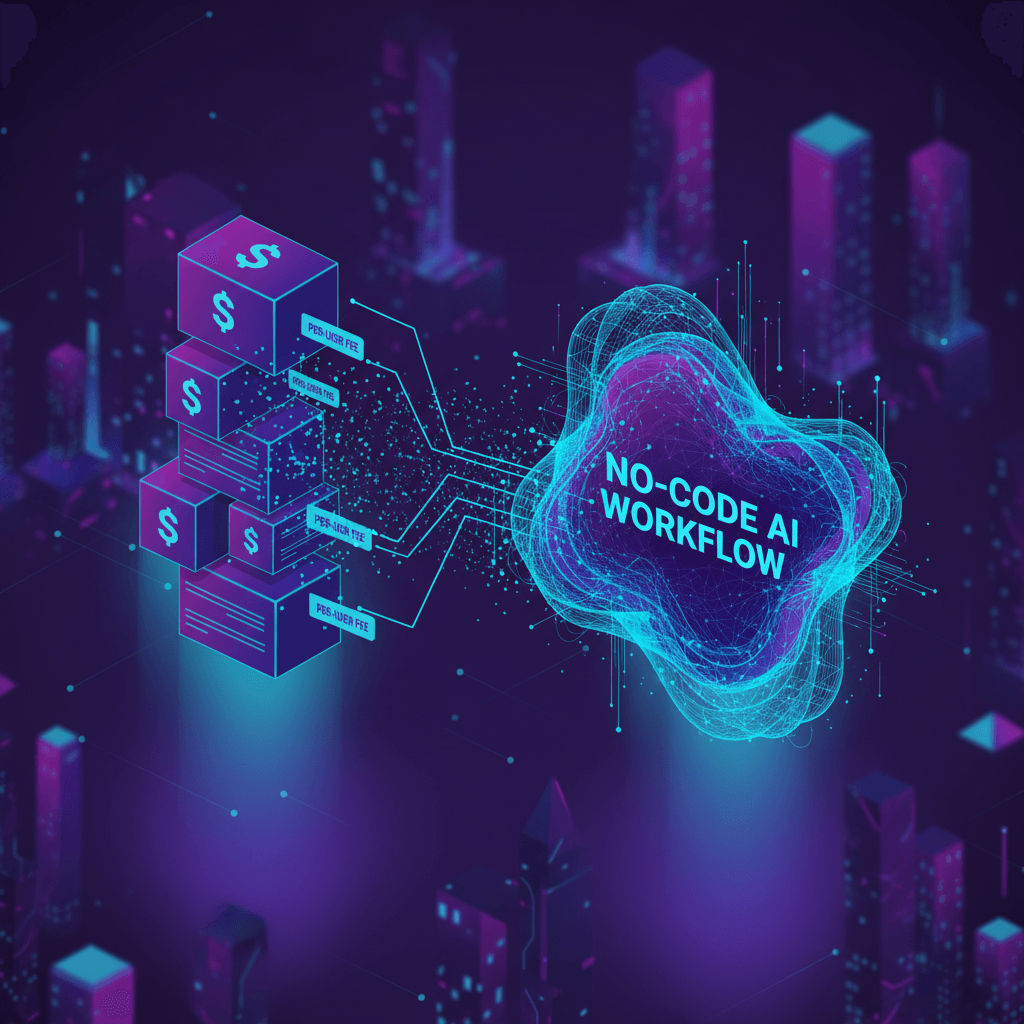
Key Signal #1 — Klarna and the Enterprise Proof That No-Code AI Tools Replacing SaaS Subscriptions Is Real
The most high-profile validation of no-code ai tools replacing saas subscriptions came from Klarna, the global fintech giant, which publicly announced it was replacing costly Salesforce and Workday subscriptions with custom AI-built software. This was not a startup cutting corners — this was a company processing billions in transactions annually, deciding that enterprise-grade SaaS platforms were no longer worth the price tag when AI could replicate and exceed their functionality at a fraction of the cost.
Klarna’s move sent a clear signal to the market: the build-vs-buy calculus has fundamentally changed. For decades, “buy” won because building was expensive, slow, and required specialized talent. Today, agentic coding tools and no-code platforms like those powered by Convex, Cloudflare, and Supabase backends enable teams to build full SaaS applications from scratch in under 60 minutes. These stacks offer real-time data sync and generous free tiers, making custom support systems effectively free to operate for many small business use cases. To understand how the build-vs-buy decision is evolving in real time, learn more from practitioners navigating this shift daily.
What Klarna demonstrated is replicable at any scale. A finance team replacing five SaaS tools with one AI-native platform eliminates not just the subscription fees but also the integration maintenance overhead — the hidden cost that SaaS vendors never advertise. When APIs break, when vendors sunset features, when per-user fees spike after a hiring round, the total cost of ownership of a traditional SaaS stack becomes punishing. The Klarna case is the enterprise canary in the coal mine for no-code ai tools replacing saas subscriptions across every sector.
Key Signal #2 — Non-Developers Are Now Building Predictive AI Models Without Writing a Single Line of Code
The second major signal accelerating no-code ai tools replacing saas subscriptions is the democratization of machine learning itself. Tools such as Jotform AI, Akkio, DataRobot, and Zams now enable non-developers — operations managers, marketing analysts, finance directors — to create predictive AI models directly from raw data uploads, without a single line of code. DataRobot, for instance, automatically tests numerous machine learning algorithms on an uploaded dataset and surfaces the best-performing model, a process that previously required a data science team earning six-figure salaries.
This capability is obliterating the justification for expensive specialized SaaS subscriptions in data analytics, business intelligence, and forecasting categories. Why pay $400 per month for a BI platform that requires a dedicated analyst to operate when a no-code AI tool can be configured by the same business owner who set up their email marketing? The answer, increasingly, is that there is no justification — and the market data reflects this. Platforms like Airtable and Glide are integrating generative AI to build enterprise-grade applications directly from spreadsheets, cutting traditional development costs from the $20,000–$200,000 range to near zero for small teams. You can watch a live demonstration of this capability in action and learn more about how practitioners are executing these builds in real time.
For SMBs specifically, this signal is transformative. The playing field between a 10-person startup and a 500-person enterprise is leveling rapidly. No-code AI tools replacing saas subscriptions gives smaller teams access to predictive analytics, automated approval workflows, and connected database systems that previously required enterprise licensing agreements and IT departments to implement and maintain.
Key Signal #3 — AI Agents Are Predicted to Replace 35% of Point-Product SaaS Tools by 2030
The third and most structurally significant signal is the emergence of AI agents as direct replacements for the point-product SaaS tools that dominate most business software stacks. Gartner’s prediction that 35% of point-product SaaS tools will be replaced by AI agents by 2030 is not a distant forecast — it is a trajectory already visible in the adoption curves of platforms enabling no-code ai tools replacing saas subscriptions today.
AI agents differ from traditional automation because they do not just execute predefined workflows — they reason, adapt, and extend their own functionality without requiring additional product subscriptions or developer intervention. A single AI agent can handle customer support ticket routing, escalation logic, follow-up scheduling, and sentiment analysis — functions that would traditionally require four separate SaaS subscriptions, each with its own per-user fee structure, API maintenance burden, and vendor relationship to manage.
The speed advantage is equally compelling. Agentic coding tools now enable teams to build full SaaS application replacements in under 60 minutes. Enterprise Pro platforms are specifically targeting expensive monthly subscriptions as the use case — the pitch is direct: describe what your $300/month tool does, and we will build you a custom version that you own outright, with no ongoing fees. For a deeper look at how AI agents are systematically replacing SaaS categories, learn more from builders who are executing this strategy at scale right now. The velocity of this shift means businesses that delay evaluating no-code ai tools replacing saas subscriptions are accumulating a compounding competitive disadvantage.
Expert Perspectives on No-Code AI Tools Replacing SaaS Subscriptions
“I replaced 5 SaaS tools my finance team was paying for with one AI platform, and built all 5 workflows live on screen. No per-user fees. No integrations to maintain.”
“Traditional AI app development can cost anywhere from $20,000 to $200,000 and take months to complete. With no-code tools, anyone can design and launch AI apps in a fraction of the time — sometimes in just minutes.”
“Gartner predicts that 35% of point-product SaaS tools will be replaced by AI agents by 2030.” — Gartner Research
These perspectives converge on a single thesis: the economic and technical barriers that made SaaS subscriptions the default choice for business software have been systematically dismantled. The experts building and deploying no-code AI systems are not speaking theoretically — they are documenting live cost eliminations and workflow consolidations that would have been impossible 24 months ago.
Key Data Summary: The Cost Case for No-Code AI
| Metric | Traditional SaaS Stack | No-Code AI Alternative |
|---|---|---|
| Monthly cost (finance ops team) | $200–$800+/month | $0–$50/month (free tiers) |
| Custom AI app development cost | $20,000–$200,000 | Near $0 with no-code platforms |
| Build time for custom workflow | Weeks to months | Minutes to 60 minutes |
| Per-user fees | Yes — scales with headcount | None on most no-code platforms |
| Integration maintenance | Ongoing IT burden | Minimal — native connectors |
| SaaS tools replaced by AI agents by 2030 (Gartner) | — | 35% of point-product tools |
Business Implications for SMBs: Why No-Code AI Tools Replacing SaaS Subscriptions Changes Everything
For small and medium-sized businesses, the strategic implications of no-code ai tools replacing saas subscriptions extend far beyond cost savings — though the cost savings alone are compelling enough to justify immediate action. Consider a typical 15-person professional services firm currently running a SaaS stack that includes a CRM, a project management tool, a document automation platform, a scheduling tool, and a basic analytics dashboard. At conservative pricing, that stack costs $600–$1,200 per month. Over five years, that is $36,000–$72,000 in subscription fees for software the business does not own and cannot customize without paying for expensive add-ons or developer time.
No-code AI tools replacing saas subscriptions flips this model entirely. Platforms like Zite allow business owners to describe their needs in natural language — “I need a client approval workflow connected to my invoice database with automated follow-up reminders” — and automatically build the solution. No per-user fees. No integration maintenance. No vendor lock-in. The business owns the workflow and can modify it as needs evolve without filing a support ticket or upgrading to an enterprise tier.
For businesses ready to move beyond generic SaaS tools, the path forward involves two core capabilities: intelligent workflow automation and AI-powered customer interaction. Our n8n Workflow Automation Services enable businesses to build custom, owned automation pipelines that replace multiple SaaS subscriptions with a single, maintainable system. Simultaneously, deploying purpose-built AI Chatbot Solutions eliminates the need for expensive customer support SaaS platforms by handling qualification, routing, and resolution autonomously. Together, these capabilities represent exactly the kind of consolidated, no-code AI infrastructure that is making traditional SaaS stacks obsolete for forward-thinking SMBs.
The competitive advantage is compounding. Businesses that adopt no-code AI tools replacing saas subscriptions today are not just saving money — they are building institutional knowledge in AI-native operations that will widen the gap between them and slower-moving competitors every quarter.
Actionable Predictions: What Happens Next With No-Code AI Tools Replacing SaaS Subscriptions
Based on current adoption curves, expert forecasts, and the structural economics of no-code AI platforms, here are specific, time-bound predictions for the trajectory of no-code ai tools replacing saas subscriptions:
- By Q4 2025: At least 40% of SMBs actively evaluating their SaaS stacks will pilot at least one no-code AI replacement, driven by free-tier availability and zero-integration-cost entry points.
- By mid-2026: The CRM and project management SaaS categories will face measurable churn pressure as no-code AI platforms reach feature parity for businesses under 50 employees.
- By 2027: Businesses that have not consolidated their SaaS stacks using no-code AI will be paying 2–3x more per workflow than competitors who have, creating a structural cost disadvantage.
- By 2030: Gartner’s 35% replacement prediction for point-product SaaS tools will prove conservative — the actual replacement rate will exceed 50% as AI agent capabilities compound.
- Within 18 months: The concept of paying per-user fees for standard business software will be recognized as an outdated pricing model, with no-code AI alternatives offering equivalent functionality at flat or zero cost.
Next Steps: How to Start Replacing Your SaaS Stack Today
The evidence is unambiguous: no-code ai tools replacing saas subscriptions is not a future trend — it is a present reality with documented cost eliminations, enterprise proof points, and a clear Gartner-validated trajectory. The question for every business owner and operations leader is not whether to evaluate this shift, but how quickly to move.
Start by auditing your current SaaS stack. List every subscription, its monthly cost, its per-user fee structure, and its primary use case. Then map each tool against the no-code AI alternatives now capable of replicating its core functionality. The overlap will surprise you. For most SMBs, 60–70% of their SaaS spend is immediately addressable through no-code ai tools replacing saas subscriptions with platforms available today. The businesses winning the next decade of competition are the ones building owned, AI-native operations infrastructure now — not renting software that someone else controls, prices, and can sunset at will.
Your Team Is Drowning In Repetitive Tasks
We automate them with AI so you can focus on growth