
AI Agents Replacing SaaS Tools: The $2.4 Trillion Disruption Nobody Is Talking About Loudly Enough
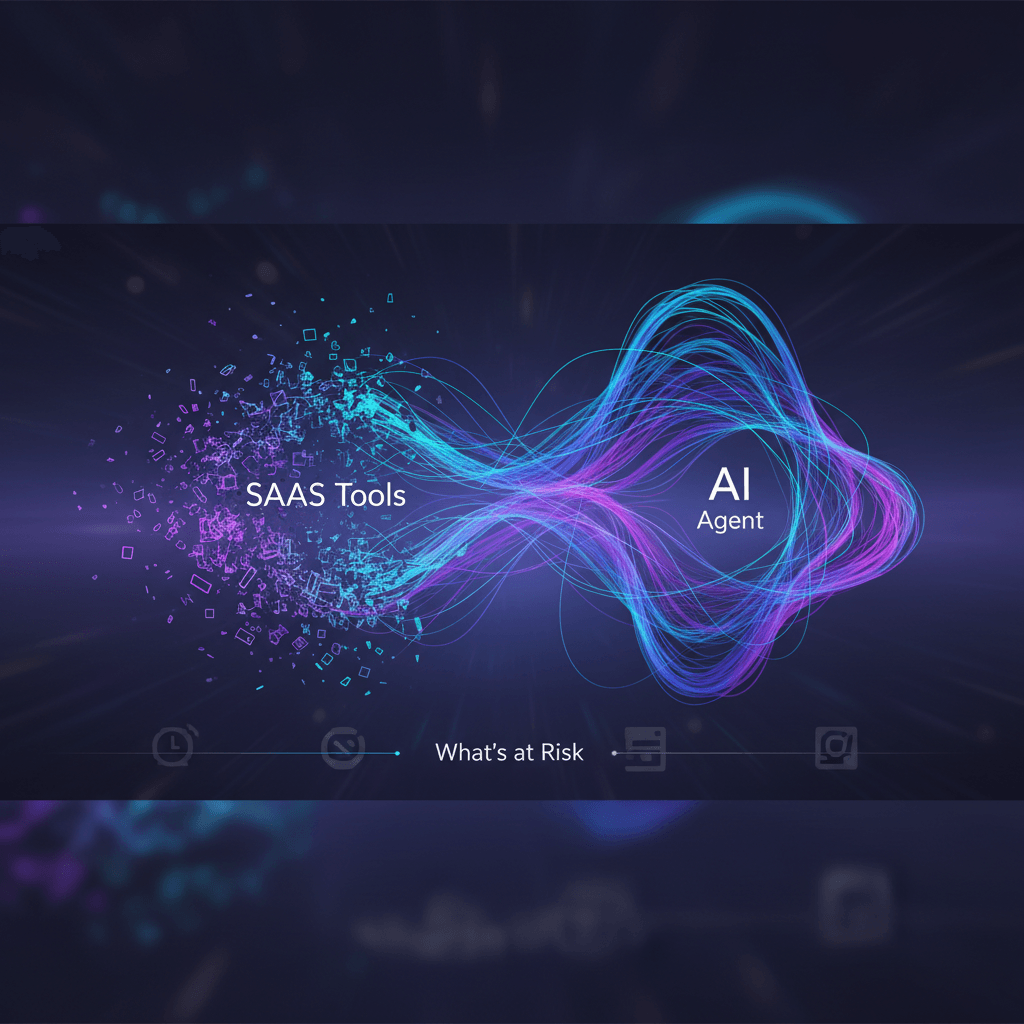
AI agents replacing SaaS tools is no longer a distant forecast — it is an accelerating market reality that will reshape how every business buys, deploys, and thinks about software. According to McKinsey, AI-powered automation stands to unlock $2.4 trillion in potential labor cost savings by 2030, and a significant portion of that value will come directly at the expense of the point-product SaaS ecosystem that has dominated enterprise technology spending for the past two decades. If your business still relies on a fragmented stack of single-purpose software subscriptions, the clock is ticking.
The SaaS model built its empire on a simple promise: buy a specialized tool, solve a specific problem. CRM for sales. Helpdesk for support. Scheduling software for operations. Reporting dashboards for analytics. For years, this worked beautifully — until AI agents arrived and began doing all of those jobs simultaneously, autonomously, and at a fraction of the cost. The question is no longer whether ai agents replacing saas tools is happening. The question is how fast, how completely, and which businesses will be positioned to benefit rather than be blindsided.

The Current State: A SaaS Stack Under Siege
The SaaS industry grew into a $197 billion market by 2023 by solving discrete problems with discrete products. The average mid-sized business today runs between 130 and 170 SaaS applications simultaneously — each with its own license fee, onboarding process, integration overhead, and data silo. This fragmentation was tolerable when there was no better alternative. That alternative now exists, and enterprises are paying close attention.
Gartner has issued one of the most consequential forecasts in enterprise software history: by 2030, 35% of point-product SaaS tools will be replaced by AI agents or absorbed within larger agent ecosystems of major SaaS providers. To put that in perspective, one in three specialized software tools currently occupying a line item on your IT budget is at existential risk within the decade. Deloitte reinforces this trajectory with equally striking data — learn more about how up to half of all organizations will allocate more than 50% of their digital transformation budgets toward AI automation as early as 2026, with agentic AI investments potentially reaching 75% of companies that same year.
What makes this disruption different from previous technology waves is the nature of what AI agents can do. Unlike traditional automation tools that execute rigid, rule-based scripts, modern AI agents reason, adapt, and orchestrate multi-step workflows across systems without human intervention. They do not just automate a task — they replace the category of software that was previously required to manage that task. The shift from software-as-a-service to intelligence-as-a-service is not incremental. It is architectural. And the businesses that recognize this distinction early will have a decisive competitive advantage over those still debating whether to upgrade their helpdesk ticketing system.
Key Signal #1 — AI Agents Replacing SaaS Tools in Customer Service at Unprecedented Speed
Perhaps nowhere is the displacement of legacy SaaS tools more visible — or more measurable — than in customer service. Gartner projects that by 2026, 75% of all customer service interactions will be handled by AI agents, up from just 25% in 2023. That is a tripling of AI penetration in less than three years, and it carries direct implications for billion-dollar SaaS platforms like Zendesk, Freshdesk, Intercom, and ServiceNow.
These platforms were built around the assumption that human agents need software tools to manage their workflows. Ticketing systems, knowledge bases, escalation queues, CSAT surveys — all of these features exist to support human labor. When AI agents handle 75% of interactions autonomously, the entire product architecture of traditional customer service SaaS becomes redundant infrastructure. You do not need a ticket routing system when an AI agent resolves the issue before a ticket is created. You do not need a CSAT survey workflow when sentiment analysis is embedded in the agent’s real-time reasoning loop.
Early adopters are already reporting dramatic results. Companies deploying conversational AI agents for tier-1 support are seeing resolution rates above 80% without human escalation, response times drop from hours to seconds, and support costs fall by 40-60%. These are not marginal efficiency gains — they are category-level disruptions. Our AI Chatbot Solutions are already enabling SMBs to replicate enterprise-grade autonomous support at accessible price points, demonstrating that this transformation is not reserved for Fortune 500 budgets.
The signal is unambiguous: ai agents replacing saas tools in the customer service category is not a future scenario. It is a 2025 operational reality for any business willing to act on the data.
Key Signal #2 — Vertical AI Agents Consolidating Entire SaaS Categories
The second major signal driving ai agents replacing saas tools is the emergence of vertical AI agents — domain-specific autonomous systems that do not merely automate one function but consolidate an entire category of tools into a single intelligent platform. This is arguably the most structurally threatening development for the existing SaaS vendor landscape. learn more about how vertical AI agents are being purpose-built for industries and functions including HR, legal, finance, marketing, and supply chain operations.
The HR technology market offers a particularly instructive case study. A typical mid-market HR stack might include separate tools for applicant tracking, onboarding, payroll processing, performance management, employee engagement surveys, time tracking, and benefits administration. Each tool represents a separate vendor relationship, a separate integration point, and a separate monthly fee. Rippling’s HR suite — increasingly augmented by AI agents — is demonstrating that a single intelligent platform can collapse this entire stack into unified, automated workflows that communicate seamlessly and reason across data that was previously siloed across seven different systems.
McKinsey estimates that AI-powered automation will replace up to 30% of traditional SaaS workflows by 2027 — and vertical consolidation is the primary mechanism through which this replacement will occur. When an AI agent can autonomously screen candidates, schedule interviews, generate offer letters, trigger onboarding workflows, process payroll adjustments, and flag performance anomalies — all within a single reasoning loop — the argument for maintaining seven separate SaaS subscriptions collapses entirely.
This is precisely why ai agents replacing saas tools represents not just a cost optimization story but a strategic architecture story. Businesses that consolidate onto intelligent vertical platforms will operate with fundamentally fewer friction points, faster decision cycles, and dramatically lower total cost of ownership than competitors clinging to fragmented legacy stacks.
Key Signal #3 — The Rise of AI Agents as a Service (AIAaaS)
The third signal cementing the trend of ai agents replacing saas tools is the emergence of an entirely new commercial model: AI Agents as a Service, or AIAaaS. This model represents a fundamental inversion of the traditional SaaS value proposition. Instead of paying a monthly license for software that your team must learn to use, configure, and maintain, businesses now subscribe to autonomous agents that simply execute outcomes — no training, no configuration overhead, no user adoption curve.
The implications for SaaS vendors are existential. The SaaS business model depends on seat-based or usage-based licensing tied to human users interacting with software interfaces. AIAaaS eliminates the human user from the equation entirely for a growing class of business processes. You do not buy a seat for an AI agent. You pay for outcomes — leads generated, tickets resolved, reports produced, data entries completed. This is a fundamentally different economic relationship between businesses and their technology infrastructure.
learn more about how leading analysts now describe AI agents as the emerging “operating layer of work” — the connective intelligence that sits above disparate data systems and executes complex business logic autonomously. This framing is critical: rather than replacing one SaaS tool at a time, AI agents are positioning themselves as the orchestration layer that makes individual SaaS tools increasingly optional.
Businesses exploring this model can start with orchestration platforms like n8n, which allow AI agents to connect existing systems while gradually automating the workflows that currently require human intervention and dedicated SaaS tooling. Our n8n Workflow Automation Services help companies build exactly this kind of intelligent orchestration layer — one that bridges today’s SaaS investments with tomorrow’s fully agentic operating model. The transition need not be disruptive when approached with the right architecture from the outset. learn more about how businesses are already making this transition successfully.
Expert Perspectives: What Industry Leaders Are Saying
“By 2030, 35% of point-product SaaS tools will be replaced by AI agents or absorbed within larger agent ecosystems of major SaaS providers.” — Gartner
“AI agents have already taken over many functions that SaaS tools used to handle — particularly in customer service, sales outreach, data entry, scheduling, reporting, and internal communications.” — RejoiceHub
“By 2026, AI Agents won’t just change the SaaS landscape — they will own it.” — SkillyAI
These perspectives, drawn from analysts, researchers, and technology strategists, converge on a single conclusion: the displacement of legacy SaaS tools by AI agents is not a theoretical possibility being debated in academic papers. It is an active market transformation being tracked by the world’s most credible research institutions and experienced firsthand by early-adopter businesses across every industry. The divergence between organizations that act on this intelligence now versus those that wait for the transition to become undeniable will define competitive positioning for the rest of the decade.
Key Data Summary: AI Agents vs. SaaS Tools
| Metric | Current State | Projected State | Source |
|---|---|---|---|
| Point-product SaaS tools replaced by AI agents | Early displacement phase | 35% replaced by 2030 | Gartner |
| Customer service interactions handled by AI | 25% (2023) | 75% by 2026 | Gartner |
| Traditional SaaS workflows replaced by AI | ~10-15% | 30% by 2027 | McKinsey |
| Orgs allocating 50%+ of digital budgets to AI | ~20% | 50% of organizations by 2026 | Deloitte |
| Companies investing in agentic AI | Growing rapidly | 75% of companies by 2026 | Deloitte |
| Potential labor cost savings from AI automation | Early realization | $2.4 trillion by 2030 | McKinsey |
Business Implications for SMBs: Why Small Businesses Face the Highest Stakes
Large enterprises have dedicated IT departments, vendor negotiation leverage, and transformation budgets that allow them to navigate the shift toward ai agents replacing saas tools at a measured pace. Small and mid-sized businesses do not have that luxury — but they do have a structural advantage that is rarely acknowledged: agility. SMBs can pivot their technology architecture faster, with fewer legacy commitments and political obstacles, than any enterprise organization. The question is whether they recognize the window before it closes.
For SMBs, the financial argument for embracing ai agents replacing saas tools is compelling on its own terms. The average SMB spends between $15,000 and $50,000 annually on SaaS subscriptions across their operational stack. A significant portion of that spend covers tools that AI agents can now replicate — or surpass — at a fraction of the cost. Consolidating from a 15-tool stack to a 5-tool stack augmented by intelligent agents can reduce software spend by 40-60% while simultaneously improving operational throughput. That is not a marginal efficiency gain. That is a structural cost advantage over competitors who remain locked into legacy subscription models.
Beyond cost, the competitive implications are profound. An SMB that deploys AI agents for customer service, sales outreach, reporting, and internal communications is effectively operating with the functional capacity of a team twice its headcount. In markets where speed of response, personalization at scale, and operational consistency determine customer loyalty, ai agents replacing saas tools gives smaller businesses an ability to compete with enterprises that was previously impossible.
The hybrid model currently emerging — where AI agents layer on top of existing SaaS systems to connect and automate processes — provides a practical on-ramp for SMBs that cannot afford a full stack replacement overnight. Starting with workflow orchestration that automates the highest-friction, highest-cost processes creates immediate ROI while building the organizational muscle to expand AI agent deployment progressively. The businesses that begin this journey in 2025 will be operating at a fundamentally different capability level by 2027 than those that wait.
Actionable Predictions: What Happens Next and When
- Q3 2025: AI agents will overtake traditional chatbot SaaS tools as the dominant deployment model for customer-facing automation, with adoption accelerating among SMBs as AIAaaS pricing reaches sub-$500/month entry points.
- End of 2025: At least three major point-product SaaS vendors in the scheduling, reporting, and data entry categories will announce pivot strategies, acquisitions, or significant product restructuring in direct response to AI agent displacement.
- 2026: Deloitte’s forecast will prove accurate — 75% of companies will have active agentic AI investments, and the term “SaaS stack” will begin to feel as dated as “on-premise software” does today.
- 2027: McKinsey’s 30% SaaS workflow replacement threshold will be reached or exceeded, with vertical AI agents having consolidated HR, customer service, and sales operations categories most aggressively.
- 2028-2030: The Gartner 35% displacement forecast will likely prove conservative. Businesses that built AI-native operating models in 2025-2026 will demonstrate productivity multiples that accelerate the remaining holdout organizations to migrate, compressing the timeline.
Next Steps: How to Position Your Business Ahead of the Curve
The evidence is conclusive: ai agents replacing saas tools is the defining enterprise technology transition of this decade. The data from Gartner, Deloitte, and McKinsey does not describe a possible future — it describes an unfolding present that will reward early movers and penalize late adopters with compounding disadvantage. The businesses that thrive through this transition will be those that audit their current SaaS spend for displacement risk, identify the highest-value automation opportunities in their specific operational context, and begin building AI agent infrastructure before competitive pressure forces a reactive scramble.
Start by mapping the workflows in your business that currently require dedicated SaaS tools but could be orchestrated by an intelligent agent. Customer service, sales outreach, scheduling, reporting, and data management are the highest-probability displacement candidates in the near term. Then build the connective tissue — the workflow orchestration layer — that positions your business to expand AI agent deployment as the technology matures and the AIAaaS market scales. The window for strategic advantage is open. The question is whether you will walk through it.
Your Team Is Drowning In Repetitive Tasks
We automate them with AI so you can focus on growth